


Entry-Level Artificial Intelligence Jobs: Roles, Skills, and How to Get Hired in 2025

Table Of Content
- Are Entry-Level AI Jobs Growing or Shrinking?
- Common Entry-Level AI Roles in 2025
- What Employers Expect: Core Skills for Entry-Level AI
- Market Reality: How AI Is Changing Early-Career Work
- Day-in-the-Life: Responsibilities by Role
- How to Become Competitive: A Practical Roadmap
- Frequently Asked Questions
- Final Take
Artificial intelligence is reshaping early-career pathways, creating new roles while raising the skills bar for traditional entry-level jobs. Understanding which roles are truly “entry-level,” what skills employers want, and how to stand out in a shifting labor market is essential for breaking in during 2025.
Are Entry-Level AI Jobs Growing or Shrinking?
AI is transforming—not eliminating—early-career roles, with routine tasks automated and expectations shifting toward AI fluency, critical thinking, and quality control from day one. Employers are cautious: major surveys report that a significant share of leaders plan to replace some entry-level tasks with AI, and many have already begun doing so, altering traditional on-ramps for graduates. At the same time, new roles such as data curators, AI trainers, and junior AI ethics specialists are emerging as organizations operationalize AI at scale.
-
The World Economic Forum’s 2025 outlook notes that many employers expect workforce reductions where AI can automate tasks, underscoring the need for new graduates to demonstrate differentiated skills and AI literacy.
-
Market coverage in 2025 highlights that entry-level positions are being displaced in some sectors, while others are redesigned to focus on review, oversight, and strategic interpretation of AI outputs.
Common Entry-Level AI Roles in 2025
While titles vary by company size and industry, these roles frequently appear with junior or entry designations:
-
AI Research Assistant: Supports experiments, data preparation, literature reviews, and model evaluation for research teams.
-
Machine Learning Intern/Junior ML Engineer: Implements baselines, runs experiments, writes data pipelines, and assists with model training under supervision.
-
Data Analyst/Junior Data Scientist: Cleans data, builds dashboards, performs exploratory analysis, and contributes to simple models or business insights.
-
AI Software Developer/Junior ML Engineer: Integrates models into applications, builds APIs, handles inference, and maintains deployment scripts.
-
NLP/Computer Vision Junior Engineer: Assists with dataset creation, fine-tuning, evaluation, and error analysis in language or vision tasks.
-
AI Trainer/Prompt Specialist: Crafts prompts, labels data, evaluates generated outputs, and improves model alignment and quality at scale.
Bootcamps, universities, and career platforms consistently list these as accessible entry points for candidates with the right fundamentals and project experience.
What Employers Expect: Core Skills for Entry-Level AI
The baseline skill set blends software engineering foundations with applied ML:
-
Programming: Proficiency in Python plus experience with libraries like NumPy, pandas, scikit-learn, and at least one deep learning framework (PyTorch/TensorFlow).
-
Math & Statistics: Comfort with linear algebra, probability, statistics, and basic calculus for model intuition and evaluation.
-
ML Fundamentals: Understanding supervised/unsupervised learning, model selection, overfitting/regularization, and evaluation metrics.
-
Data Handling: Data cleaning, feature engineering, data pipelines, and SQL; ability to assemble clean inputs for training and analysis.
-
Algorithms & CS Foundations: Data structures, complexity, and software development best practices for scalable, maintainable code.
-
System & MLOps Basics: Version control, containerization (Docker), cloud familiarity, and deployment concepts (APIs, monitoring) are increasingly expected even in junior roles.
Guides from career platforms and educator sites converge on these competencies as entry-level requirements in 2025.
Market Reality: How AI Is Changing Early-Career Work
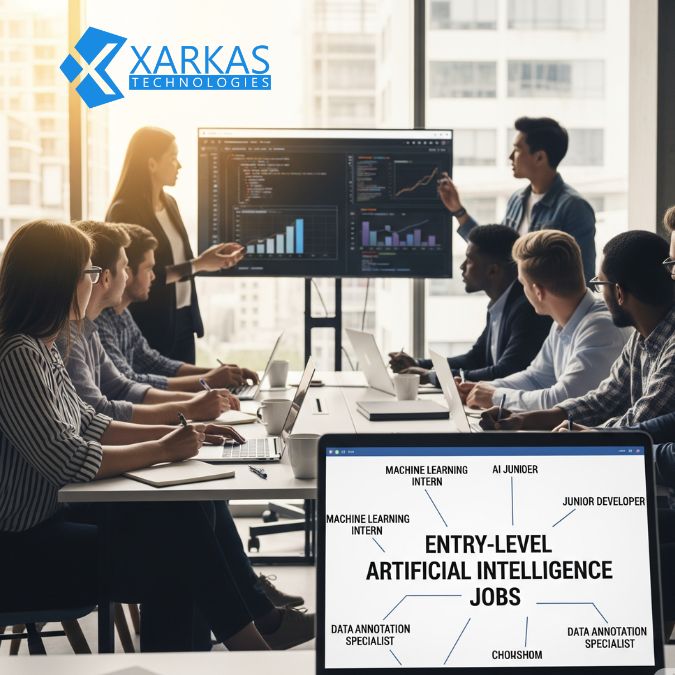
-
Many entry-level duties—data gathering, basic reporting, initial code scaffolding—are now AI-assisted, shifting junior roles toward oversight, debugging, interpretation, and human-in-the-loop quality control.
-
Leaders expect accelerated career progression for capable juniors who leverage AI effectively, as responsibilities move up the value chain faster than in the past.
-
Organizations are also piloting new junior roles around data quality, governance, and ethics to keep systems safe, compliant, and high-performing.
These shifts mean candidates who can collaborate with AI tools, critique outputs, and ensure reliability stand out in hiring funnels.
Day-in-the-Life: Responsibilities by Role
-
Junior ML Engineer: Build experiments, clean datasets, train/evaluate models, optimize inference, contribute to productionization, and write tests/documentation.
-
Data Analyst/Junior DS: Translate business questions into metrics, build dashboards, run A/B test analyses, and communicate insights to non-technical stakeholders.
-
AI Software Developer: Integrate ML services, design APIs, manage model deployments, and optimize latency/costs in production environments.
-
AI Trainer/Prompt Specialist: Curate prompts, annotate outputs, enforce quality rubrics, and provide feedback loops that improve model behavior over time.
Training providers and industry descriptions emphasize this blend of coding, analysis, and applied ML practice at the junior level.
How to Become Competitive: A Practical Roadmap
-
Build a Portfolio: End-to-end projects showing data wrangling, modeling, evaluation, and lightweight deployment (e.g., a small API or app) demonstrate job-readiness more than certificates alone.
-
Specialize Lightly: Choose one lane—NLP, CV, recommender systems, or tabular ML—and build two or three strong, real-world projects in that area.
-
Learn Tools Employers Use: Git, Docker, SQL, PyTorch/TensorFlow, scikit-learn; cloud basics and API integration to move beyond notebooks.
-
Quantify Impact: In project write-ups, report metrics (accuracy, F1, latency, cost), show error analysis, and discuss trade-offs like fairness and robustness.
-
Practice Human-in-the-Loop: Showcase eval frameworks, prompt testing, data labeling strategies, and alignment considerations—skills in demand as AI augments workflows.
-
Tailor Applications: Align resume bullets to job descriptions (skills and responsibilities), and reflect required keywords for ATS screening on platforms like Coursera’s career guidance.
Authoritative skill guides from learning platforms and engineering resources align with this roadmap for 2025 hiring.
Frequently Asked Questions
What counts as “entry-level” in AI now?
Roles labeled junior/associate/intern, or requiring 0–2 years experience, that focus on applied ML, data analysis, or AI-integrated software tasks are common gateways in 2025.
Do I need a master’s degree?
Not strictly—strong portfolios, internships, and demonstrable skills can substitute, but advanced degrees help for research-heavy tracks and can widen opportunities.
Which skills move the needle fastest?
Python, ML fundamentals, data handling, SQL, model evaluation, and basic deployment skills—paired with projects showing measurable outcomes—consistently unlock interviews.
Is AI killing entry-level jobs?
AI is automating foundational tasks, compressing traditional ladders, and prompting employers to seek higher readiness; at the same time, it is creating new early-career roles around training, evaluation, and governance.
Final Take
Breaking into AI at the entry level in 2025 requires proving real-world readiness: build a focused portfolio, master the fundamentals, learn to work with and critique AI systems, and target roles designed for junior contributors in research assistance, ML engineering, analytics, and AI training. The candidates who can align domain sense, coding rigor, and AI literacy will find durable opportunities—even as the market evolves rapidly under automation pressures.




No Comment! Be the first one.