


Table Of Content
- Introduction to AI as a GPT
- Understanding General Purpose Technologies
- Historical Examples of GPTs
- Characteristics of GPTs
- How AI Functions as a General Purpose Technology
- Pervasive Application Across Industries
- Continuous Improvement and Innovation
- Spawning Complementary Innovations
- The Transformative Impact of AI
- Revolutionizing Healthcare
- Reshaping Manufacturing and Industry
- Transforming Transportation
- Autonomous Vehicles
- Smart Traffic Management
- AI in Everyday Life
- Personal Assistants and Smart Homes
- Entertainment and Content Creation
- Economic Implications of AI as a GPT
- Productivity Gains
- Job Displacement and Creation
- Wealth Distribution Challenges
- Challenges and Concerns
- Ethical Considerations
- Bias and Fairness
- Privacy and Security Issues
- The Future of AI as a General Purpose Technology
- Potential Developments
- Integration with Other Technologies
- Conclusion
- FAQs
Introduction to AI as a GPT
Have you ever stopped to think about how deeply technology has woven itself into the fabric of our daily lives? From the smartphone in your pocket to the algorithms recommending your next favorite show, we’re living in an era where innovation isn’t just rapid—it’s exponential. At the heart of this transformation lies artificial intelligence, or AI, which many experts now recognize as a general purpose technology (GPT). But what does that really mean?
A general purpose technology is essentially a breakthrough innovation that fundamentally transforms economies and societies. Think of electricity, the steam engine, or the internet—each of these revolutionized how we live, work, and interact. AI sits comfortably in this elite category because of its ability to permeate virtually every sector, continuously evolve, and spark entirely new innovations we haven’t even imagined yet.
Understanding General Purpose Technologies
Historical Examples of GPTs
To truly grasp why AI deserves the GPT label, let’s take a quick trip down memory lane. The steam engine didn’t just power trains—it reshaped manufacturing, transportation, and urbanization. Electricity didn’t merely light up homes; it enabled everything from refrigeration to telecommunications. The internet? Well, we all know how that turned out. Each of these technologies shared common traits that made them transformative rather than merely useful.
Characteristics of GPTs
What makes a technology “general purpose”? Economists and historians have identified three key characteristics. First, it must be pervasive—applicable across multiple industries and use cases. Second, it needs to improve continuously over time, becoming more efficient and capable. Third, and perhaps most importantly, it must generate complementary innovations, inspiring new products, services, and business models that wouldn’t exist otherwise.
AI checks all these boxes with flying colors. It’s being deployed in healthcare, finance, agriculture, entertainment, education—you name it. Machine learning algorithms get smarter with more data. And the innovations spawned by AI, from autonomous vehicles to personalized medicine, are reshaping entire industries.
How AI Functions as a General Purpose Technology
Pervasive Application Across Industries
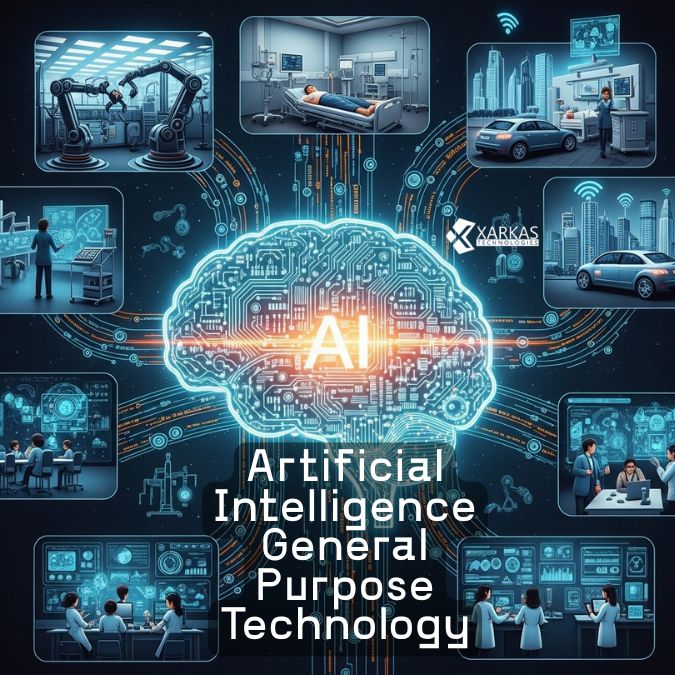
Let’s face it—there’s hardly a corner of modern life that AI hasn’t touched. In healthcare, AI algorithms diagnose diseases with remarkable accuracy, sometimes outperforming human specialists. Financial institutions use AI to detect fraud, assess credit risk, and execute trades at lightning speed. Farmers employ AI-powered drones and sensors to optimize crop yields and reduce waste.
The beauty of AI lies in its adaptability. Unlike specialized tools designed for specific tasks, AI can be trained and retrained for countless applications. This flexibility makes it incredibly valuable across diverse sectors, each with unique challenges and opportunities.
Continuous Improvement and Innovation
Here’s where things get really interesting. AI doesn’t just sit still—it learns and evolves. Machine learning models improve as they process more data, becoming increasingly accurate and efficient. What required enormous computational power and months of training a decade ago can now be accomplished in hours on standard hardware.
This trajectory of improvement isn’t slowing down either. Breakthroughs in neural network architectures, training techniques, and hardware acceleration continue to push the boundaries of what’s possible. Each advancement opens new doors, making previously impossible applications suddenly feasible.
Spawning Complementary Innovations
Think about how the internet gave birth to e-commerce, social media, cloud computing, and streaming services. AI is doing something similar. It’s not just improving existing processes—it’s enabling entirely new categories of products and services.
Consider recommendation systems that personalize your shopping experience, voice assistants that understand natural language, or generative AI that creates art and music. These innovations wouldn’t exist without AI, and they’re just the beginning. As AI capabilities expand, we’ll see complementary technologies emerge that we can’t even predict today.
The Transformative Impact of AI
Revolutionizing Healthcare
Healthcare might be experiencing the most profound AI transformation of any industry. Imagine a world where diseases are detected years before symptoms appear, where treatments are tailored to your unique genetic makeup, and where remote monitoring keeps vulnerable patients safe without constant hospital visits.
AI is making this vision a reality. Diagnostic algorithms analyze medical images with superhuman precision, catching subtle anomalies that human eyes might miss. Drug discovery, which traditionally took decades and billions of dollars, is being accelerated through AI-powered molecular modeling. Even administrative tasks like scheduling and billing are being streamlined, allowing healthcare professionals to focus on what matters most—patient care.
Reshaping Manufacturing and Industry
The factory floor of tomorrow looks dramatically different from what we’re used to. AI-powered robots work alongside humans, handling dangerous or repetitive tasks while adapting to changing conditions in real-time. Predictive maintenance systems monitor equipment health, scheduling repairs before breakdowns occur and saving companies millions in downtime.
Quality control has reached new heights too. Computer vision systems inspect products at speeds and accuracy levels impossible for human inspectors, ensuring consistency while reducing waste. Supply chain optimization algorithms coordinate complex logistics networks, balancing inventory levels, shipping routes, and production schedules with remarkable efficiency.
Transforming Transportation
Autonomous Vehicles
Self-driving cars have captured public imagination for good reason—they represent a fundamental reimagining of personal transportation. AI systems process data from cameras, radar, and lidar sensors, making split-second decisions that keep passengers safe while navigating complex urban environments.
Beyond personal vehicles, autonomous trucks promise to revolutionize freight transportation, potentially addressing driver shortages while improving safety and efficiency. Delivery drones and robots are already operating in some cities, bringing packages directly to doorsteps with minimal human intervention.
Smart Traffic Management
But AI’s transportation impact extends beyond individual vehicles. Smart traffic systems use AI to optimize signal timing based on real-time traffic flow, reducing congestion and emissions. Public transit systems employ predictive algorithms to adjust schedules and routes dynamically, improving service while controlling costs.
AI in Everyday Life
Personal Assistants and Smart Homes
You’ve probably interacted with AI today without even thinking about it. Voice assistants like Siri, Alexa, and Google Assistant use natural language processing to understand your requests and provide helpful responses. Smart home devices learn your preferences, adjusting lighting, temperature, and security settings automatically.
These conveniences might seem minor individually, but collectively they’re changing how we interact with technology. Instead of adapting to rigid interfaces, our devices are learning to understand us—our habits, preferences, and needs.
Entertainment and Content Creation
Remember when finding something to watch meant flipping through TV channels or browsing video store shelves? Streaming platforms use sophisticated AI algorithms to recommend content tailored to your tastes, learning from your viewing history and behavior patterns.
But AI isn’t just helping us find content—it’s creating it too. Generative AI tools produce music, artwork, written content, and even video, democratizing creative capabilities that once required years of specialized training. This technology raises fascinating questions about creativity, authorship, and the future of artistic expression.
Economic Implications of AI as a GPT
Productivity Gains
Like previous GPTs, AI promises substantial productivity improvements across the economy. When routine tasks are automated, workers can focus on higher-value activities requiring creativity, judgment, and interpersonal skills. Businesses can scale operations without proportionally increasing headcount, improving margins and competitiveness.
Studies suggest AI could contribute trillions of dollars to global GDP over the coming decades. These gains stem from increased efficiency, better decision-making powered by data insights, and entirely new revenue streams enabled by AI capabilities.
Job Displacement and Creation
Here’s where things get complicated. Yes, AI will displace certain jobs—particularly those involving routine, predictable tasks. But history suggests GPTs ultimately create more jobs than they eliminate, though often different types of roles requiring new skills.
The transition period can be painful, though. Workers whose skills become obsolete face difficult choices: retrain, relocate, or accept lower-paying work. Societies must grapple with how to support people through these transitions while preparing the next generation for an AI-enabled economy.
Wealth Distribution Challenges
There’s a darker possibility we can’t ignore. If AI’s benefits accrue primarily to capital owners and highly skilled workers, we could see wealth inequality worsen significantly. When productivity gains don’t translate into broader prosperity, social cohesion suffers.
Addressing this challenge requires thoughtful policy interventions—perhaps updated tax structures, stronger social safety nets, or new models for distributing economic gains. The technical challenges of AI pale in comparison to these social and political questions.
Challenges and Concerns
Ethical Considerations
As AI systems make increasingly consequential decisions, ethical questions multiply. Who’s responsible when an autonomous vehicle causes an accident? How do we ensure AI-powered hiring tools don’t perpetuate discrimination? What happens when deepfake technology makes it impossible to trust video evidence?
These aren’t just philosophical puzzles—they have real-world implications affecting people’s lives, livelihoods, and safety. Developing ethical frameworks for AI development and deployment is crucial, yet progress lags behind technological advancement.
Bias and Fairness
AI systems learn from data, and if that data reflects historical biases, the AI will too. We’ve seen algorithmic bias in criminal justice systems, lending decisions, and hiring processes. The challenge is that these biases are often subtle and hard to detect, baked into statistical patterns rather than explicit rules.
Ensuring fairness requires conscious effort—diverse development teams, careful data curation, ongoing monitoring, and willingness to redesign systems when problems emerge. Technical solutions exist, but implementing them requires commitment and resources.
Privacy and Security Issues
AI’s appetite for data creates obvious privacy concerns. The more information systems collect about us, the more vulnerable we become to breaches, misuse, and surveillance. Facial recognition technology, while potentially useful, raises troubling questions about constant monitoring and tracking.
Security challenges extend beyond privacy. As AI systems control critical infrastructure—power grids, water systems, transportation networks—they become attractive targets for malicious actors. Ensuring these systems are robust against attack is paramount.
The Future of AI as a General Purpose Technology
Potential Developments
We’re still in the early stages of AI’s development as a GPT. Today’s systems, impressive as they are, remain narrow—excellent at specific tasks but lacking general intelligence. The next frontier involves creating more flexible, adaptable AI that can transfer learning across domains and handle novel situations with human-like reasoning.
Advances in areas like few-shot learning, transfer learning, and neural-symbolic AI promise to bridge this gap. As these technologies mature, we’ll see AI tackle increasingly complex, open-ended problems requiring creativity and abstract thinking.
Integration with Other Technologies
AI’s true potential emerges when combined with other technologies. Imagine AI-optimized quantum computers solving problems currently beyond our reach, or AI-designed materials with properties we can barely imagine. The convergence of AI with biotechnology, nanotechnology, and robotics will likely produce innovations that seem like science fiction today.
This integration amplifies both opportunities and risks. The same technologies that could cure diseases and solve climate change could also create new threats we’re ill-prepared to handle. Navigating this future requires wisdom, foresight, and international cooperation.
Conclusion
Artificial intelligence has earned its place among history’s most transformative general purpose technologies. Its pervasive applications, continuous improvement, and ability to spawn complementary innovations mirror the patterns we’ve seen with electricity, the steam engine, and the internet. From healthcare to transportation, manufacturing to entertainment, AI is reshaping every aspect of modern life.
Yet this transformation brings challenges alongside opportunities. Job displacement, wealth inequality, bias, privacy concerns, and ethical dilemmas demand attention and action. The question isn’t whether AI will transform our world—it already is. The real question is whether we’ll shape that transformation wisely, ensuring its benefits are broadly shared while mitigating its risks.
As we stand on the cusp of this AI-powered future, one thing is certain: the decisions we make today about how to develop, deploy, and govern this technology will echo for generations. Let’s make them count.
FAQs
1. What makes artificial intelligence a general purpose technology rather than just another innovation?
AI qualifies as a general purpose technology because it meets three critical criteria: pervasive applicability across multiple industries, continuous improvement over time, and the ability to generate complementary innovations. Unlike specialized technologies designed for specific uses, AI can be adapted to countless applications, from healthcare diagnostics to financial trading to agricultural optimization. Its learning capabilities mean it gets better with use, and it enables entirely new products and services that wouldn’t exist otherwise.
2. How will AI affect employment in the coming decades?
AI’s employment impact will be complex and multifaceted. While it will certainly automate routine tasks and displace some jobs, history suggests general purpose technologies ultimately create more employment opportunities than they eliminate, though in different sectors requiring different skills. The transition period poses challenges, particularly for workers in roles vulnerable to automation. Success depends on investing in education, retraining programs, and social support systems that help people adapt to an AI-enabled economy.
3. Can AI really be unbiased, or will it always reflect human prejudices?
AI systems learn from data created by humans, so they inevitably reflect patterns in that data—including biases. However, with conscious effort, we can build fairer AI systems than human decision-makers by explicitly identifying and correcting for bias during development. This requires diverse development teams, careful data curation, ongoing monitoring, and willingness to redesign systems when problems emerge. Perfect objectivity may be impossible, but substantial improvement over current human-driven processes is achievable.
4. What are the biggest risks associated with AI becoming more powerful and widespread?
Major risks include job displacement without adequate social support, increasing wealth inequality, algorithmic bias perpetuating discrimination, privacy erosion through pervasive surveillance, security vulnerabilities in AI-controlled critical infrastructure, and potential misuse by malicious actors. Perhaps most concerning is the possibility of developing powerful AI systems whose goals aren’t properly aligned with human values. Addressing these risks requires technical research, thoughtful regulation, international cooperation, and ongoing public dialogue.
5. How soon will we see artificial general intelligence that matches or exceeds human capabilities across all domains?
Predicting the timeline for artificial general intelligence (AGI) is notoriously difficult, with experts offering estimates ranging from a few decades to never. Current AI systems, despite impressive capabilities in specific domains, lack the flexible, general reasoning abilities humans possess. Significant technical hurdles remain, including common-sense reasoning, transfer learning across vastly different domains, and understanding causality. While progress continues rapidly, whether and when we’ll achieve human-level AGI remains uncertain.





No Comment! Be the first one.